Table of Contents
ToggleBusan is one of Overwatch‘s most dynamic and visually stunning maps, and it’s where games are won or lost on the back of smart positioning and decisive teamplay. Whether you’re grinding ranked or prepping for competitive tournaments, understanding how to navigate this three-stage escort-payload map separates the casual players from those climbing the ladder. The map’s open sightlines, verticality, and multiple engagement zones demand precision and adaptability, there’s no room for mindless brawling. This guide breaks down everything you need to master Busan, from reading the layout to executing flawless team rotations and shutting down enemy pushes before they start.
Key Takeaways
- Busan’s three stages each demand different strategies—prioritize bridge control on stage one, navigate around sniper-heavy plaza on stage two, and prepare burst ultimates for the compressed alley on stage three.
- High-ground positioning is critical to winning Busan engagements, but isolated high-ground players get picked off instantly; always pair vertical positioning with tank support or teammate backup.
- Master hero flexibility by adapting your composition between stages—heroes like Reinhardt and Widowmaker dominate certain areas while struggling in others, so swapping heroes mid-round is essential to success.
- Effective communication through concise, positional callouts (“left high,” “restaurant flank,” “group up”) reduces decision-making latency and prevents staggered engagements that lead to team wipes.
- Control engagement tempo by either playing slow (poke-heavy teams) or fast (burst-damage teams) to leverage your composition’s strengths and exploit enemy weaknesses.
- Avoid predictable mistakes like extending into sniper fire without cover, burning all ultimates in one fight, or failing to track enemy ultimate economy—discipline in cooldown and ultimate spending separates ranked climbers from casual Overwatch players.
Understanding Busan’s Layout and Key Locations
Busan divides into three distinct stages, each requiring different approaches and awareness. The opening area features tight corners and buildings: the second stage opens up with a central plaza and multiple flanking routes: the final stage compresses the playspace around a narrow alley leading to the payload endpoint. Knowing these layouts cold is the foundation for everything else.
Map Zones and Strategic Positions
The first stage of Busan pivots around a central bridge and two primary buildings: the main structure on the left and a smaller two-story building on the right. The bridge itself is a critical chokepoint, controlling it dictates the entire stage’s tempo. Teams that secure bridge positioning force enemies into awkward flanks or time-intensive rotations around the buildings.
The center plaza on stage two is the map’s most dangerous zone. It’s wide open, minimal cover, and sniper-friendly. Smart teams avoid the plaza’s center: instead, they hug building edges and use the elevated walkways on either side. The back-left path (near the restaurant area) provides a protected flank route that aggressive teams abuse relentlessly if defenders don’t respect it.
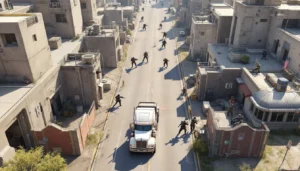
Stage three’s final stretch is brutally narrow. A single alley with tight walls and minimal high ground makes this a perfect setup for defensive ultimates and close-range burst damage. Attackers must compress their formation here, making them vulnerable to coordinated defensive ability usage.
Key landmarks to call in comms:
- Bridge (stage 1): Central engagement zone: first-responder high ground
- Restaurant/Bakery (stage 2): Left-side flank route: sniper nest potential
- Plaza Center (stage 2): Open, dangerous: avoid pure center, hug edges
- Alley (stage 3): Compressed final approach: defense ultimate territory
High Ground Advantages and Control Points
Busan’s verticality punishes ground-level play. On stage one, the roofs of both primary buildings offer elevated positioning. The left-side building’s roof is easier to reach and provides excellent sightlines down toward the bridge: defenders love perching here with hitscan heroes. The right-side building is slightly lower but still valuable for playmaking and poke damage.
Stage two’s high ground is split between the elevated walkways flanking the plaza. These walkways don’t offer massive height advantage, but they grant sightlines over the central plaza and make enemies below vulnerable to cleave damage from area-of-effect (AoE) abilities. Smart positioning on these walkways forces attackers to respect angles and diverts their gaze from the actual payload.
Stage three has minimal high ground, this stage heavily favors close-range brawl heroes and defensive utility. The few slight elevation changes near the alley’s entrance are more about angle denial than dominant positioning.
Control point principles:
- Early rotation = early high ground. Teams that move vertical first lock it down before enemies establish.
- High ground without numbers is a liability. Isolated high-ground players get picked off: coordinate with teammates before committing.
- Fallback high ground matters. Always scout secondary vertical positions you can rotate to when primary high ground becomes untenable.
Hero Selection and Composition for Busan
Busan’s three stages demand roster flexibility. A composition that dominates stage one might crumble on stage two’s open plaza or stage three’s brawl-heavy alley. Teams that win Busan adapt mid-game, swapping heroes between stages rather than forcing the same six from start to finish.
Best Tanks for Map Control
Reinhardt remains the safest tank pick on Busan. His barrier establishes protection in chokepoints (bridge, alley), and his hammer threat forces enemies to respect close-range engagement. On stage one and three, Reinhardt’s presence dominates, enemies can’t walk through his barrier without taking shield pressure. His mobility is limited, though: he struggles when teams need vertical positioning or rapid rotations.
D.Va thrives on Busan because of her mobility and matrix utility. She can chase flankers, contest high ground easily, and her Defense Matrix blocks hitscan poke during plaza approaches. She’s especially valuable on stage two when teams need to move through open space without feeding burst damage to enemy hit-scan heroes.
Sigma offers flexibility. His kinetic grasp negates incoming burst damage (crucial against Widowmaker spam in the plaza), and his ultimate ability forces enemies into bad positions. He’s slightly less effective in tight spaces like the bridge or alley but excels when teams need survivability in mid-range engagements.
Avoid Wrecking Ball and Hammond variants that emphasize pure brawl momentum. Busan punishes heroes without defensive tools or positioning flexibility. Winston can work in organized team setups but requires excellent communication and spacing.
Damage Heroes That Thrive on Busan
Widowmaker is a Busan staple, the map’s open sightlines (especially stage two plaza) are her playground. Her effective range dominates bridge and plaza areas. Teams with strong Widowmaker play win Busan duels decisively. But, Widowmaker feels weak on stage three’s cramped alley where close-range heroes crush her.
Tracer excels at harassing enemy backlines through the restaurant flank on stage two and punishing high-ground isolation on stage one. Her low-HP pool is risky in open plaza, but smart positioning and ability cycling keep her alive while she creates chaos. Stage three’s narrow alley limits her effectiveness unless enemies extend too far.
Genji’s mobility mirrors Tracer’s strengths, he can reach unexpected flank positions and dive enemy supports. His ability to secure stage-three corners and chase enemies through tight spaces gives him late-stage scaling.
Ashe and McCree provide reliable hitscan damage without mobility reliance. They excel in stage one and two where positioning matters more than constant repositioning, though both struggle against aggressive close-range dive if they’re caught out of position.
Avoid Symmetra and Torbjorn unless the team builds specifically around them. Busan’s open design limits their effectiveness compared to more position-flexible damage heroes.
Support Positioning and Survival
Lucio is arguably Busan’s premier support. His speed boost carries teams through stage-two plaza, his wallride reaches unexpected high-ground positions, and his proximity healing supports aggressive tank play. Lucio’s ultimate (Sound Barrier) also shuts down burst damage during risky push windows.
Ana provides consistent poke damage and ultimate economy through her rifle. She’s positioned mid-range, maintaining safety while supporting teammates. Her sleep dart catches diving threats, and her anti-heal grenade is invaluable against enemy supports. But, Ana is vulnerable to close-range threats, making positioning paramount on stage three.
Zenyatta offers raw damage output and Discord Orb, which makes enemies extremely vulnerable. He pairs well with burst-damage compositions. His immobility makes him risky in open plaza scenarios, he’s better suited to stage one and three’s cover-heavy gameplay.
Baptiste supplies healing and immortality field (temporary invulnerability boost for teammates). His lamp is invaluable during risky ultimates or critical team fights. He’s flexible across all three stages and provides insurance against coordinate burst-damage enemy setups.
Support survival priorities:
- Maintain 10-15 meters behind your frontline during open-map phases (stage two).
- Find cover between healing actions. Don’t stand still: even small repositioning dodges burst damage.
- Position where you can retreat or rotate quickly when threats breach your safe zone.
- Call out ultimate readiness to your team. Team awareness of your defensives (lamp, barrier, sleep) prevents solo-lost teammates.
Attacking Strategies on Busan
Pushing payload through Busan demands synchronized engagements, cooldown discipline, and tempo control. Attackers that stagger engagements or leak resources to poke damage lose momentum and get ground down by defender attrition.
Initiating Engagements Effectively
Stage one initiation should prioritize bridge control. Rather than brute-forcing through the center, smart teams position high ground first. Assign a mobile player (D.Va, Tracer, Genji) to claim the left-building roof 15 seconds before your main engagement. Once secured, the rest of the team engages into defenders forced to split attention between ground-level payload pressure and rooftop threats.
Timing matters enormously. Initiating into prepared defensive ultimates (Reinhardt earthshatter, Zenyatta Sound Barrier) is feeding. Wait for enemy defensive abilities to spend or predict when they’re ready and time your engagement to avoid them. Use picks on isolated enemies, a dead defender is a numerical advantage that makes pushing exponentially easier.
Stage two’s plaza requires tempo control. Attackers shouldn’t charge center-plaza blindly into enemy hitscan fire. Instead, advance methodically along edges. Hug left-side building structures, move via restaurant flank, or take right-side elevated paths. These routes let teams reach payload without eating raw plaza damage. As your team compresses near payload, a coordinated frontline push (through the plaza center) follows, with enemies now fragmented and unable to collapse efficiently.
Stage three’s alley demands ultimate-heavy initiation. The cramped space is where defensive ultimates (Reinhardt shatter, Sigma grasp) shine. Attackers typically bunch ultimate usage, a Zarya grav into a Tracer bomb or Genji blade creates burst so overwhelming defenders can’t respond. Solo initiating without teammate coordinated ultimates is a guaranteed wipe.
Pushing Through Choke Points
Chokepoints (bridge on stage one, alley on stage three) are where defenders farm ultimate charge punishing grouped enemies. Attackers must deprioritize direct choke charge and instead:
-
Probe for defensive position and ability cooldowns. Send a mobile hero through the choke, trade ability usage (not Health) with defenders, and retreat. This intel reveals enemy setup and forces cooldown spending.
-
Use flank routes to create positional advantage. Rather than pushing directly through bridge, send Tracer or Genji around buildings to threaten backline defenders. When defenders respond to flank threats, the main team pushes payload through the now-undermanned choke.
-
Layer damage sources. Once you commit to choke push, ensure multiple angles are attacking simultaneously, Widowmaker from high ground, hitscan from flank, tanks from center. Fragmented defenders can’t focus-fire single targets: they splinter and lose cohesion.
-
Use ultimate economy correctly. Spend 2-3 ultimates to break one defensive ultimate in a favorable exchange ratio. A Zarya grav into Reinhardt shatter is a fair trade because your team then has follow-up momentum while defenders rebuild economy.
Research from The Loadout and competitive guides shows successful attackers spend 70% of their ultimate economy on choke breaks. The remaining 30% reserves for post-break team fight securing.
Pro tempo tip: If your team hasn’t gained ground within 45 seconds of choke initiation, reset. Regroup, rebuild ultimate economy, and try again with reset numbers. Feeding 1v5 into a choke loses rounds faster than patience.
Defensive Tactics and Holding Ground
Defense on Busan is about denial and attrition, not raw fighting. Defenders with superior positioning, cooldown preservation, and ultimate tracking systematically crush attackers who lack coordination. The goal isn’t to win every skirmish, it’s to make attacking so resource-costly that attackers eventually arrive at your chokepoint with insufficient ultimate economy to break through.
Setting Up Defensive Positions
Stage one defense hinges on bridge control. Position your tank (Reinhardt or Sigma) slightly back from bridge to bait aggression, then use your positioning advantage to collapse on isolated attackers. Your damage hero should secure high ground, specifically, the left-building roof. This creates a two-angle threat: ground-level tank blocks bridge, roof damage denies easy approach. Supports position behind the tank, maintaining sight lines to teammates and backline threats.
Anti-flank positioning is critical. Assign one off-tank or mobile player to hold the restaurant flank route on stage two and building-side rotations on stage one. This player’s sole job is early-warning and disruption, force Tracers and Genjis to commit early or retreat, preventing uncontested flank access to your backline.
Stage two defense spreads thinner across the plaza. Rather than collapsing one choke, defenders must guard multiple approaches: center plaza, left flank, right flank. A single unsupported defender is picked off easily. Pair defenders in 2v2 or 3v2 positioned groups across the map. Your Widowmaker or hitscan hero perches on high ground, creating deterrent presence against clustering. Your tanks position near high-ground supports, creating multiple “islands” of defensive presence rather than a single brawl blob.
Stage three defense returns to choke consolidation around the alley. Position similar to stage one but more compressed. Use the slight elevation changes near the alley entrance. Your tank stays tight with supports: your damage heroes position for cross-fire coverage. The alley’s narrowness means attackers must compress, your job is making that compression lethal through burst damage and defensive ultimates.
Defensive setup checklist:
- All six players visible or accountable (no solo defenders)
- High ground claimed and held by designated player
- Supports positioned to survive burst (behind cover, range advantage)
- Tank positioned to body-block threats without feeding massive damage
- Flank routes actively contested: no undefended approaches
Managing Cooldowns and Ultimate Economy
Defenders who waste cooldowns early (e.g., Reinhardt shatters into a single Tracer) get punished by coordinated attacker ultimates later. Cooldown management is discipline:
Ability spending hierarchy:
- Only spend defensive abilities to prevent picks. If your support is about to die to Widowmaker, sleep dart the sniper or use Defense Matrix. If your tank is isolated, use gap-closure tools.
- Never use defensive abilities against poke damage. Let your teammates heal minor chip: save cooldowns for critical situations.
- Communicate cooldown status. When your anti-heal is on cooldown, tell your team “anti on cooldown, respect Ana”: when your matrix is ready, teammates know they can aggressive peek.
Ultimate economy on defense:
Defenders should consistently aim for 4-5 ultimate-ready players when attackers arrive at a chokepoint. Attackers typically burn 2-3 ultimates breaking through: if defenders have 5, they respond with decisive 2-3 back, then cleanly win the next fight with remaining ultimate advantage.
Common mistake: Holding ultimates so long that attackers arrive with overwhelming numbers anyway, and your ultimates become “greedy ultimate waste” rather than “defensive insurance.” Spend them when trades are favorable (1 defensive ultimate holding 3 attacker ultimates = win).
Ult tracking framework:
- Count attacker ult timing from previous fight. Did Widowmaker ultimate last fight? She has ult again in ~45 seconds.
- Estimate based on damage output. High-damage attackers (Zarya, Genji) build ult fast: low-damage (Ana) slow.
- Communicate predictions: “Tracer bomb in 30 seconds, cluster avoidance.”
Comparative ult usage: If attackers burned 2 ultimates and you used 1, you’re down ultimate economy. Backup, reset, and don’t force the next fight until economies balance again.
Team Coordination and Communication
Busan punishes uncoordinated teams mercilessly. A player with superior aim but zero communication gets isolated and deleted. Conversely, a team with average mechanical skill and perfect communication dominates through synchronized positioning and combined fire.
Calling Positions and Rotations
Establish a communication system with your team. Use positional callouts tied to map landmarks:
- “Left high” (left-building roof on stage one)
- “Bridge high” (slightly elevated area mid-bridge)
- “Restaurant” (flank route on stage two)
- “Plaza right” (right side elevated paths on stage two)
- “Alley hold” (defensive position on stage three)
Clear callouts prevent duplicated positioning. If two players claim the same high ground, one is backline unprotected. Standardize your team’s callout language, if your team says “left high,” everyone understands that’s the same position.
Rotation callouts are equally critical:
- “Stack team” or “group up”: Everyone consolidates at a single location before engaging. Prevents staggered fights.
- “Rotate left/right”: Team moves sideways to avoid a threat or find a better angle. Damage heroes rotate first, supports follow.
- “Back up” or “reset”: Full retreat. Stop feeding damage and reset for the next fight attempt.
- “Ult combo ready”: Announce when your ultimate is charged and ready to execute a predetermined combination (e.g., Zarya grav + Genji blade).
Initiative callouts during fights:
- “Pick on X”: Everyone focuses fire on a single target until eliminated. Prevents scatter damage and ensures numerical advantage.
- “Peel on Y”: Rotate toward a teammate being dived by enemies. Stop the immediate threat before returning to primary engagement.
- “High ground contested”: Enemy just took your claimed high ground position: reassess or counter-push.
Japanese gaming esports coverage from Siliconera features professional teams with hyper-efficient comms. Watch clips and note how their callouts are concise (2-3 words max), immediate (no delay between enemy action and response callout), and tied to specific plays.
Real-time communication reduces decision-making latency. Instead of your team debating where to go, one designated shot-caller (often a flex support or tank) issues clear orders: “Group left, high ground, push through restaurant.” Everyone executes without hesitation.
Communication timing principles:
- Dead players stay quiet. If you’re eliminated, don’t spam calls. One “they’re grouped right” helps: five callouts per second creates noise.
- Positive framing. “Ult ready” and “let’s push” build momentum. “We suck” and “this is unwinnable” demoralize.
- Predict enemy actions. “Tracer bomb in 20 seconds, spread out” prevents a wipe. “Widow repositioning back” warns teammates.
- Acknowledge successful calls. When a play works, brief positive reinforcement (“nice focus”) strengthens future compliance.
Common Mistakes to Avoid on Busan
Even strong players make predictable errors on Busan. Recognizing and eliminating these mistakes accelerates improvement.
Positioning Errors and Punishing Mistakes
Mistake 1: Isolated high-ground positioning. Players claiming high ground without tank support or teammate presence nearby get picked off instantly. Enemies rotate a single flanker, delete the isolated player, then roll the 5v6. High ground is only strong when teammates can respond to dives with counter-presence.
Correction: Establish high-ground players with explicit peel assignments. Your main tank guards a high-ground damage hero’s flank. If enemies commit multiple players to threaten high ground, your team should rotate out and regroup rather than defend a compromised position.
Mistake 2: Extending past safe range into sniper fire during plaza approach. Plaza crossing demands discipline. Teams that cluster center-plaza and take raw Widowmaker spam bleed HP before engagement. Attackers arriving at stage-two payload having already lost 1-2 players or suffered critical health deficits lose follow-up fights.
Correction: Hug edges during plaza transit. Move along left-building wall or right-side elevated paths. Only compress center-plaza once the team is close to payload and enemies are forced to split defensive focus. This minimizes sniper exposure.
Mistake 3: Backline supports positioned too far forward. Supports in middle-of-the-fight positioning get caught in crossfire and deleted before they can peel or heal. Ana caught center-plaza with no cover is a guaranteed pick.
Correction: Supports should position 10-15 meters behind the engagement zone. Use cover consistently. If the fight relocates and you can’t maintain cover, rotate backward immediately, a dead support provides zero healing and zero value.
Mistake 4: Not respecting enemy high-ground threats. Teams that ignore enemy Widowmaker or rooftop Tracer get ground down by consistent poke. Eventually, someone gets isolated and deleted.
Correction: Dedicate a player to counter-high-ground threats. If Widowmaker controls a roof, assign your Tracer or Genji to invade that space and displace her. Force her rotation or elimination. Then reclaim high ground for your team.
Ultimate Tracking and Economy Mismanagement
Mistake 5: Burning all ultimates in a single team fight. Teams that use Zarya grav, Genji blade, Tracer bomb, and Ana ultimate in one 20-second fight win that skirmish but arrive at the next engagement with zero ultimates. If enemies are halfway toward their ultimates, this economy deficit is catastrophic.
Correction: Prioritize ult spending. Use 2-3 ultimates to break a defensive hold, then disengage and rebuild. Save 1-2 ultimates as “next fight insurance.” This discipline ensures you consistently arrive at critical chokes with ult advantage.
Mistake 6: Not tracking enemy ultimates. If you don’t know whether Reinhardt has shatter, you can’t plan confidently. Teams that rush chokepoints into fully-charged defensive ultimates feed guaranteed wipes.
Correction: Audit enemy ult status constantly. After every team fight, estimate when key enemy ultimates are ready. “Reinhardt shattered twice, he’ll have ult in 40 seconds” helps your team schedule the next engagement.
Mistake 7: Predictable ultimate timing. Teams that always ult the same pattern (Zarya into Genji every time) get punished. Smart defenders predict the combo and spread formation, negating grav efficiency.
Correction: Vary your ultimate sequences. Sometimes use Zarya grav into focus-fire burst. Sometimes use Genji blade first to secure picks, then Zarya grav for cleanup. Unpredictability makes defenders uncertain and makes mistakes.
Mistake 8: Sharing ultimate economy callouts with nearby enemies. In LAN or team environments, accidentally loud callouts (“grav ready, let’s go”) reach enemy ears, and they rotate defensively or use their own ultimates preemptively.
Correction: Use team comms exclusively. Mute team chat from enemy proximity during online play. Communicate ult status to your team only, never aloud in open space.
Advanced Tips for Competitive Play
Once fundamentals are solid, higher-tier play revolves around tempo manipulation, psychological pressure, and meta adaptation.
Map Control and Tempo Play
Tempo is the pacing of engagements. Fast tempo favors teams with superior mechanics and healing output: slow tempo favors teams with superior positioning and cooldown discipline. Understanding your team’s strengths lets you control tempo to your advantage.
If your team has a strong Widowmaker and Ana (high-damage, poke-oriented), you want slow tempo. Position defensively, take favorable long-range duels, let enemies bleed HP chasing you. Eventually, enemies arrive at chokepoints already damaged and vulnerable.
If your team has burst-damage heroes (Zarya, Genji, Tracer) and strong frontline tanks, you want fast tempo. Rush chokepoints aggressively, force quick decisions, blow ultimates before enemies consolidate. Chaos favors burst-optimized teams.
Controlling tempo as attackers:
- Push chokes faster to stress enemy defensive positioning.
- Use poke damage to damage enemy stack before close-range engagement.
- Coordinate picks to create numbers advantage quickly, then roll forward before enemies respawn.
Controlling tempo as defenders:
- Stall enemy pushes with extended positioning (trade damage over time).
- Use cooldowns to delay rather than eliminate (force repositions without committing ultimates).
- Avoid split engagement, group up so enemies must commit overwhelming numbers to break through.
Professional esports guidance from Dot Esports emphasizes that winning teams control tempo, not just execute mechanics. Mechanical skill is table stakes: tempo control is what separates bronze from grandmaster.
Adapting to Enemy Compositions
Busan’s flexibility means you’ll face compositions ranging from hitscan-heavy (Widowmaker, McCree, Ana) to dive-heavy (Tracer, Genji, Winston) to brawl-heavy (Reinhardt, Zarya, Symmetra).
Against hitscan-heavy (Widowmaker, McCree, Ashe):
- Use cover and verticality extensively. Don’t stand still or walk predictable paths.
- Employ D.Va or Sigma to block sniper shots via matrix or kinetic grasp.
- Focus-fire the backline supports first. Lone hitscan heroes without peel are vulnerable.
- Play around sight-line denial. Use buildings, obstacles, and teammate bodies to break sniper angles.
Against dive-heavy (Tracer, Genji, Winston, D.Va):
- Position as 2v2 or 3v3 grouped teams. Solo players are isolated and dived.
- Use abilities (sleep, stun, disable) to shut down dives immediately.
- Play slightly further back than normal. Extra distance lets teammates react to dives before they delete you.
- Ensure your supports have escape routes. Ana’s high-ground positioning on stage one becomes a liability against Winston, rotate her to safer ground-level angles.
Against brawl-heavy (Reinhardt, Zarya, Doomfist, Roadhog):
- Avoid close-range engagements. Play range-heavy (Widowmaker, Ashe, Lucio).
- Use damage-over-time abilities (Ana, Torbjorn) rather than burst.
- Position at corners and angles. Brawl heroes need straight-line access to you: deny them paths.
- Ultimate-spike them. One ultimate (Ana sleep + focus-fire) stops brawl snowballs before they start.
Recognize compositional win conditions:
Every enemy composition has a primary win condition. Hitscan teams win by controlling high ground and poking from range. Dive teams win by deleting isolated targets. Brawl teams win by establishing close-range fights. Disrupt their win condition, force hitscan into close range, deny dive targets with grouping, kite brawlers, and they struggle.
As your team competes on Busan more, you’ll internalize these matchup tendencies and adapt swaps mid-round with minimal discussion. A support realizing “their Genji is too strong, we need a hitscan” recommends the swap: your team makes the change and suddenly the Genji is hunted rather than enabled. That’s adaptive play.
Conclusion
Mastering Busan requires synthesis of map knowledge, hero familiarity, team coordination, and meta understanding. Start with layout fundamentals, learn every building, every sightline, every flank route until you navigate blind. Then layer hero selection discipline: pick heroes that synergize with your team and counter enemy threats. Develop communication discipline: precise, timely callouts compound mechanical skill into coordinated dominance.
Avoid the traps that hold players back: isolated high-ground positioning, wasted cooldowns, untracked enemy ultimates, and predictable playstyles. Study professional Overwatch competitive guides and esports coverage to see high-level players applying these principles at speed and precision you should aspire toward.
The beauty of Busan is its flexibility. Three stages, countless compositional matchups, multiple viable strategies, the map punishes one-dimensional play while rewarding teams that adapt, communicate, and execute fundamentals. Climb through ranked by internalizing this guide’s principles, spamming Busan scrims with your team, and iterating on what works. Within weeks, you’ll develop the map intuition that separates casual Busan players from those consistently climbing.